Orlando Ferreres predicted how high the dollar could rise and warned about the lack of investments

 Prefer us on Google


The dollar, the lack of investments, and uncertainty about the economic direction are once again putting pressure on market expectations. In this context, economist Orlando Ferreres analyzed the Argentine situation and predicted that the exchange rate could still rise, although without exceeding the exchange rate bands. He also warned about the difficulties in reactivating activity and projected moderate growth for 2027.
In a conversation with the MMD team, composed of Maximiliano Montenegro, Martín Genero, and Juan Pablo Marino, the consultant evaluated the escalation of country risk, the employment situation, and electoral prospects. Additionally, he estimated that the economy could grow between 2% and 3% next year, with an annual inflation rate of between 20% and 21%.
Ferreres warned about the lack of investments and weak consumption
When analyzing economic activity, Ferreres was emphatic: "The problem is that there are no investments." He explained that uncertainty about the future discourages productive projects, while consumption shows a limited recovery due to the slight improvement in real wages.
To illustrate the problem, he pointed out that, based on a GDP of $550 billion, Argentina needs to invest around $100 billion annually. However, he considered that the amounts mobilized by the Large Investment Incentive Regime (RIGI), between $7 billion and $8 billion per period, are still insufficient: "It doesn’t move the needle."
The scenario also affects the labor market, where 45% of employment is informal, with consequences for contributions to the pension and health systems. He also warned that the decrease in interest rates has not been enough to reactivate credit and that, due to the lack of demand, savers prefer to hold dollars.
The economist analyzed the exchange rate scenario and projected three scenarios for the Argentine economy in 2027.
Why country risk exceeded 1,100 points
Another focus of the interview was the escalation of country risk, which reached 1,125 points. Ferreres linked the financial deterioration to electoral uncertainty, doubts about the ability to pay the debt, and lower economic activity, which impacts revenue and forces the government to adjust spending.
He also mentioned the international context, high rates in the U.S., and the depreciation of the Brazilian real as factors complicating the local landscape. In this regard, he warned that, with a U.S. reference rate of 5% and the current country risk, financing for Argentina could reach 17% annually, a cost he described as "impossible to manage."
In this scenario, the economist considered that the country is better positioned to meet its external commitments than in other times. As an argument, he highlighted the trade surplus of between $25 billion and $30 billion, driven by agricultural exports, mining, and oil.
What could happen with the dollar and the Argentine economy in 2027
In terms of exchange rates, Ferreres supported the recent movement of the dollar and stated that it could still advance. He recalled that he had already warned about the delay of an exchange rate around $1,500 and considered that a gradual correction would allow avoiding a sharper jump next year. "I believe it can rise a bit more still," he asserted.
However, he urged moderation to prevent the exchange rate movement from being passed on to prices. In this sense, he warned that some of the main food companies have already sent lists with price increases, while the basic food basket has accumulated a 40% year-on-year increase, well above general inflation.
When projecting for the next year, the economist presented three possibilities. The most likely scenario, to which he assigned a 60% probability, contemplates economic growth of between 2% and 2.5%, with possibilities of reaching 3%, and an annual inflation rate of between 20% and 21%. A more favorable scenario would allow for an expansion of 4% to 5%, while the most negative scenario contemplates stagnation or recession with higher inflation.
To approach the base projection, Ferreres requested "that Milei calm down" and avoid erratic decisions. He also estimated that country risk could drop below 1,000 points, although it would still be far from the 402 points he considered necessary to regain access to international financing. Meanwhile, he warned that gross investment fell by 6% year-on-year in September.
Finally, Montenegro asked him how far the dollar could move and how the ceiling of the exchange rate band, set around $2,000, would influence this. Ferreres revealed that his calculation of theoretical equilibrium parity places the exchange rate at $2,300, above current values, close to $1,600.
Nevertheless, he clarified that this estimate does not imply that the dollar will necessarily reach that value. According to his projection, the exchange rate would accompany or slightly exceed inflation but would remain within the current scheme: "Within the exchange rate band, of course," he concluded.
-- Price
This content is provided for general informational purposes only and doesn't constitute financial, investment, legal, or tax advice. Any events, rewards, online promotions, or related information mentioned herein should not be considered a recommendation, solicitation, or invitation to purchase, sell, trade, or otherwise deal in any crypto assets. Crypto assets are highly volatile and may result in loss. The availability of WEEX services, products, and related events may vary by region. You are responsible for ensuring that your participation is in accordance with applicable local laws and regulations.
You may also like
Global Markets Optimistic About US Resilience, Futures Indicate Wall Street Will Rise on Black Friday

Investing $500 a Month in Coca-Cola, Realty Income, and Altria Could Generate Over $1,000 in Monthly Dividend Income by 2046
Bitcoin and Tokenized Gold: Investors Prefer Euro Transactions More

Bank of Thailand to Intervene to Prevent Excessive Fluctuations of Baht
15,400 people lost over $13 million after copying the wallet of a crypto specialist

HSBC, JPMorgan, and StoneX Conduct First Trades in Digital Gold

Quickben22 Rechecks 2018 Bitcoin Dormant Address List: Nearly 10,000 Dormant Addresses Restart Transfers After Eight Years, Transferring a Total of 245,000 BTC

Weekend Dividends: How Franklin Templeton's Tokenized Money Fund Breaks Traditional Barriers?
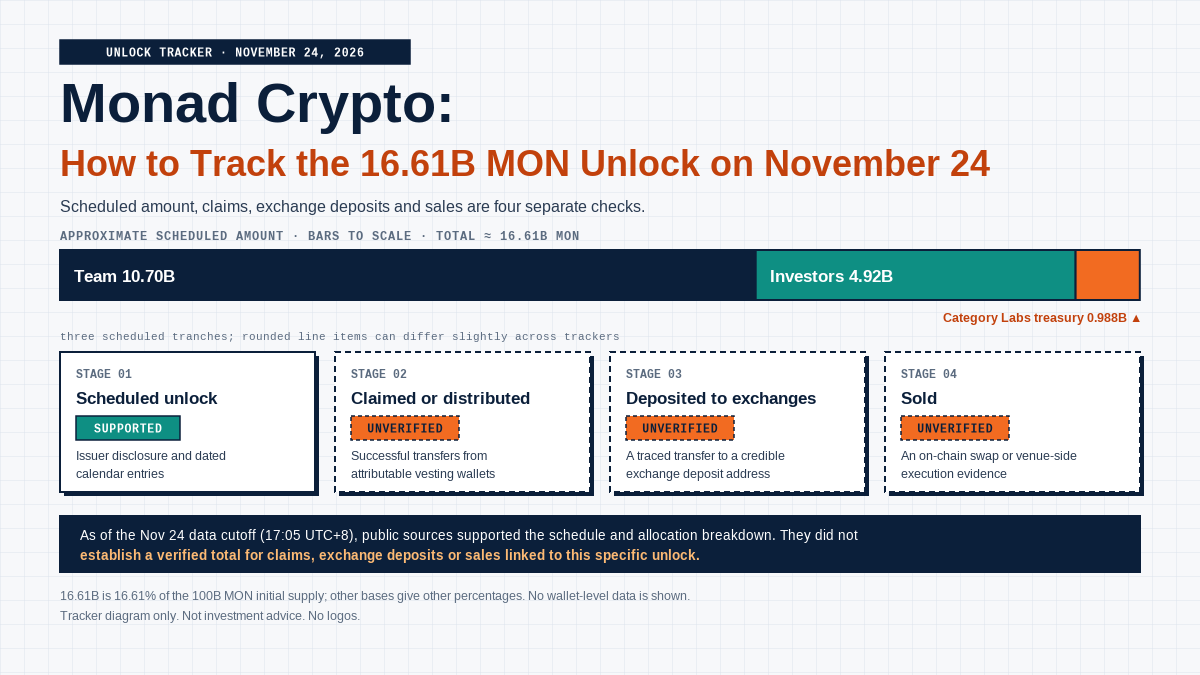
Monad Crypto: How to Track the 16.61B MON Unlock on November 24
Track Monad’s 16.61B MON unlock on November 24. See the team, investor, and treasury allocations, and learn how to verify claims and exchange deposits.

Prediction: Alphabet Will Be the World's Most Valuable Company by 2031

What Is ATX Crypto? A Beginner’s Guide to Project ATX (ATX)
Learn what ATX crypto means, why Project ATX appears under multiple Solana mint addresses, and how to tell those tokens apart from AstroX (ATX).

Ethereum ETF: $96 million in net inflows stop the November bleeding

Lee Chang-yong Discusses Potential Erosion of Capital Movement Regulations with Introduction of Won Stablecoin

Bitcoin’s supply squeeze narrative faces scrutiny after 11,000 BTC moves to Kraken

Korean Token Securities Need Connection to Overseas Blockchain Financial Infrastructure

ECB Seeks Partners for Tokenized Deposits and Securities Pilot

[Analysis] Reasons Why This Bitcoin Decline Is Different from the Past
SBF Expresses Regret Over Anthropic Sale: AI Has a 25% Chance of Destroying Humanity, Young People Should Master AI

VIX Soars to Highest Level Since Last Year’s Tariff Turmoil, Goldman Sachs Fear Index Nears Maximum, US Stocks May Face Over $80 Billion Sell-off Next Week

Is Arthur Hayes buying the dip after moving $5M in USDC?
Bitcoin: Major Investors Return After Nine Months of Selling

Musk Regrets Spending Over $400 Million on Republican Candidates

ZRO Unlock on November 20: Why Are Supply Estimates Different?

Options Overview | AMD Sees $37.88 Million in Forward Double Call Sell, Limited Upside Ahead; Intel Shows Large Put Buys Indicating Bearish Dominance

APEC Releases Connectivity Blueprint

Institutional Withdrawal and Retail Frenzy: Why is the Eastern European Crypto Market Exhibiting 'Abnormal' Trends?

Bitcoin income ETFs promise regular payments. What do investors give up?

USD.AI Evaluates GPU Transactions at $25 Billion

Solana tokenized equities reach $1.22 billion as stock offerings expand
IoTeX adds quantum-resistant technology to developer portal
Global Markets Optimistic About US Resilience, Futures Indicate Wall Street Will Rise on Black Friday
Investing $500 a Month in Coca-Cola, Realty Income, and Altria Could Generate Over $1,000 in Monthly Dividend Income by 2046
Bitcoin and Tokenized Gold: Investors Prefer Euro Transactions More
Bank of Thailand to Intervene to Prevent Excessive Fluctuations of Baht
15,400 people lost over $13 million after copying the wallet of a crypto specialist
HSBC, JPMorgan, and StoneX Conduct First Trades in Digital Gold
Latest articles


Latest coin listings on WEEX