
JPMD vs USDC: What JPMorgan’s Ethereum Expansion Changes

 Prefer us on Google


JPMorgan’s expansion onto Ethereum brings a new development to the digital dollar market. Although JPMD and USDC are both denominated in dollars, they differ in financial structure, access requirements and intended users.
On October 19, 2026, JPMorgan’s Kinexys business announced that JPM Coin, its USD deposit token with the ticker JPMD, had launched on Ethereum. The expansion extends its institutional offering to a second public blockchain. It does not establish that JPMorgan is purchasing ETH as an investment.
So, what separates JPMD from USDC, and why might greater institutional adoption fail to produce an immediate ETH rally?
Readers following broader financial markets can explore the WEEX U.S. stock earnings prediction event and WEEX Dice Rush: Wall Street Tycoon. Availability, eligibility and rewards follow the event rules. ETH spot trading and ordinary crypto futures should not be assumed to qualify for TradFi event tasks.
JPMD vs USDC: Key Differences
JPMD is a bank deposit token available to approved institutional clients. USDC is a dollar stablecoin issued by regulated Circle entities and backed by cash and highly liquid cash-equivalent reserves.
Individuals typically access USDC through exchanges and wallets. Direct dollar minting and redemption through Circle Mint require an eligible institutional account.
Feature | JPMD | USDC |
|---|---|---|
Structure | Bank deposit token | Reserve-backed stablecoin |
Issuer framework | JPMorgan banking system | Circle issuing entities |
Value basis | Underlying bank deposit relationship | Supporting reserve assets |
Main users | Approved institutional clients | Institutions and individuals through supported services |
Common uses | Institutional payments and settlement | Payments, trading and blockchain applications |
Access | Institutional approval | Platform, jurisdiction and compliance restrictions |
Similar dollar pricing does not make these products interchangeable. Users must examine redemption arrangements, contractual rights and access conditions.
What Does JPMD’s Ethereum Expansion Change?
Bringing Bank Deposits Closer to Tokenized Assets
JPMorgan identified Ethereum’s established liquidity and tokenized asset ecosystem as reasons for the expansion. Institutions already handling assets on Ethereum can potentially access bank-issued digital cash within the same environment. www.jpmorgan.com
This could reduce operational steps between separate cash and asset systems. Actual functionality still depends on customer eligibility, supported applications and counterparties.
Public Infrastructure Does Not Mean Unrestricted Access
Ethereum is a public blockchain, but products operating on it can retain identity checks and transfer restrictions. JPMD’s deployment does not make it a freely accessible retail token.
JPMD and USDC Could Coexist
JPMD addresses institutions operating within established banking relationships. USDC serves a broader network of wallets, exchanges and payment applications.
Their positioning suggests potential overlap alongside different use cases. It does not establish that JPMD will replace USDC.
Why Can ETH Fall Despite Institutional Adoption?
The supplied WEEX API snapshot for October 20, 2026, showed ETH at 2,397.40 USDT, down 1.37% over the rolling 24-hour period. This is a historical platform snapshot, not a continuously updated quote.
Dollar Transfers Do Not Create Equivalent ETH Purchases
Moving a large amount of JPMD does not require buying the same dollar amount of ETH.
Ethereum transactions require ETH-denominated fees. The base fee is burned, while priority fees go to validators. Additional activity can increase network usage, but its impact depends on transaction frequency, computational requirements and prevailing fees. ethereum.org
Transfer Value Does Not Determine Fees Proportionally
A larger dollar transfer does not automatically generate proportionally higher fees. Institutional settlement volumes therefore cannot be directly converted into ETH burn estimates or price targets.
Other Market Forces Still Matter
ETH also responds to broader crypto conditions, capital flows, leverage and risk appetite. A deployment announcement alone cannot explain a daily price move.
For additional scenarios, see the Ethereum price prediction analysis, noting its assumptions and update date.
-- Price
What Should ETH and JPM Watchers Monitor?
For Ethereum, useful indicators include sustained JPMD activity, transaction frequency, application integrations and incremental fees.
For JPMorgan, the questions concern customer adoption, settlement efficiency and identifiable business revenue. These differ from ETH’s network economics.
Area | Useful Evidence |
|---|---|
JPMD adoption | Client participation and actual usage |
Ethereum impact | Transaction activity, fees and burn |
JPMorgan business impact | Revenue, costs and customer demand |
Market response | Volume, capital flows and broader conditions |
The JPMorgan Chase Tokenized Stock (Ondo) price prediction covers JPMon, a separate asset from JPMD and WEEX stock tokens.
How to Access Related Assets on WEEX
Step 1: Prepare Your Account and Funds
New users can register on WEEX and complete applicable checks. WEEX offers spot, futures and TradFi services and publishes Proof of Reserves information.
Existing crypto holders should select a supported deposit asset and network, obtain their WEEX address, and include any required memo or tag. Sending and receiving networks must match. Prepare USDT for the selected market.
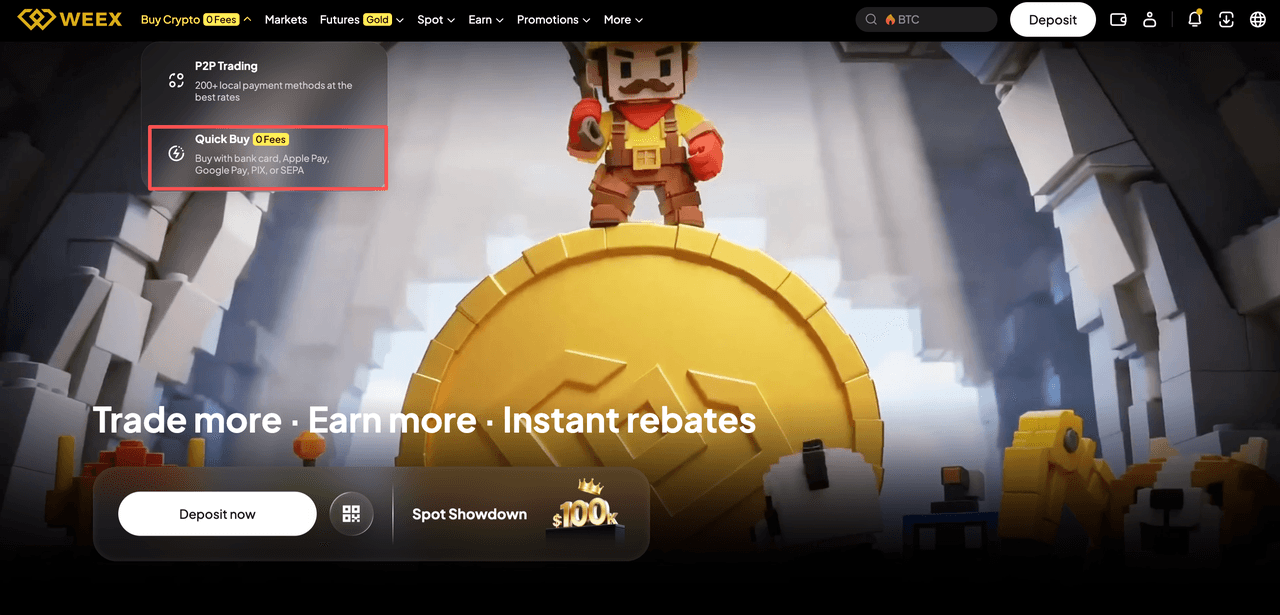
Users without crypto can check WEEX Quick Buy or the WEEX P2P marketplace. Availability and fees vary. The Ethereum buying guide provides further instructions.
Step 2: Choose the Correct Product
Available links include the ETH/USDT spot trading pair, ETH/USDT futures trading pair, JPM/USDT stock token trading pair and JPM/USDT futures trading pair. Related products can also be explored through the WEEX TradFi market.
WEEX Stock Spot 2.0 is distinct from Ondo, xStocks and other third-party assets. Its synthetic tokens track selected stock or ETF prices and trade using USDT without an external brokerage account.
Stock tokens provide no underlying share ownership, voting rights, shareholder meeting rights, dividends or other shareholder benefits. Orders are not routed to Nasdaq, NYSE or external brokers. Execution prices come from WEEX’s corresponding market.
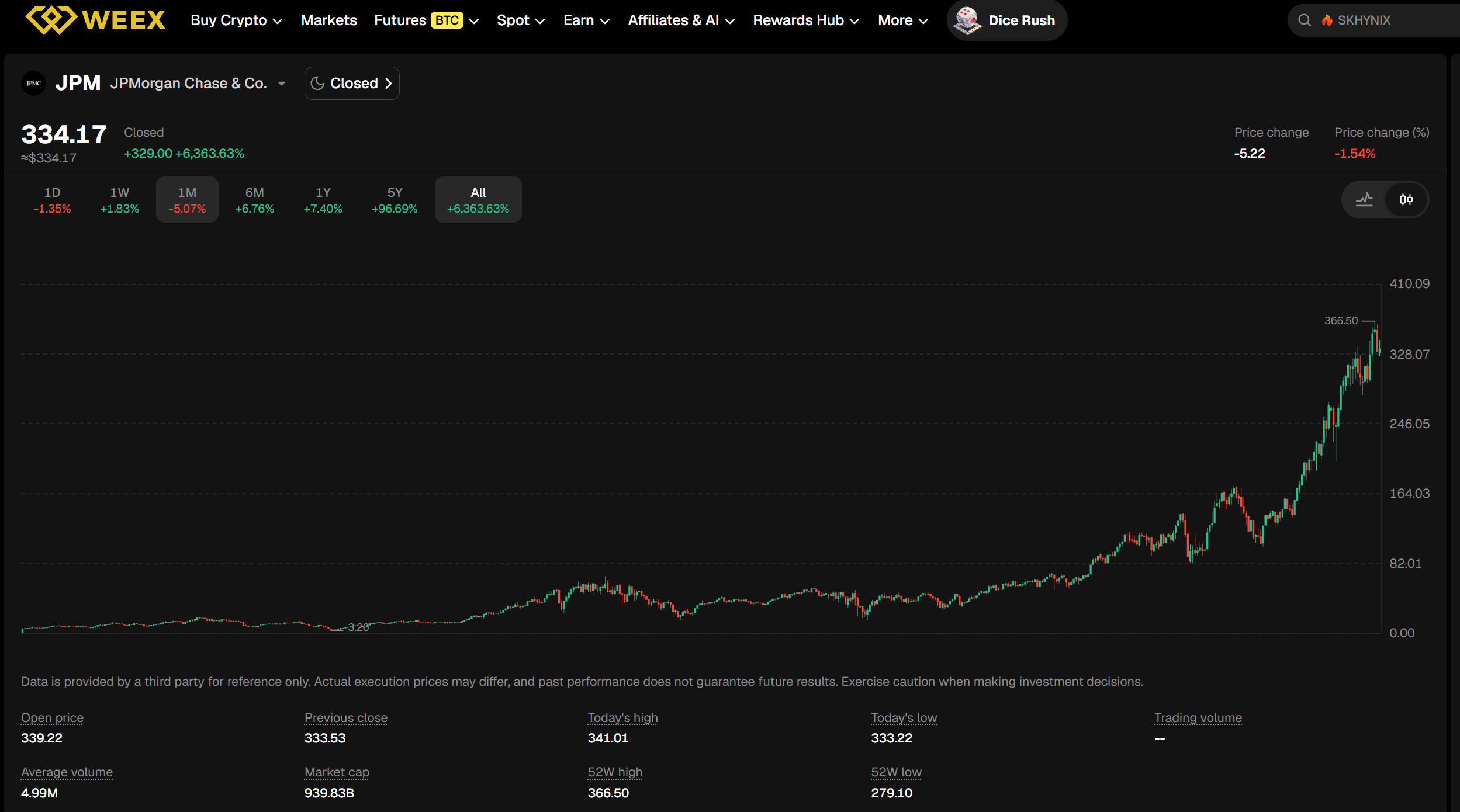
The JPMorgan Chase Tokenized Stock (Ondo) buying guide concerns a separate product. None of these trading links represents purchasing JPMD.
Step 3: Review and Submit Orders
For ETH spot, choose a Market Order or Limit Order, enter the quantity, review fees and submit.
For stock tokens, enter the amount, select a supported order type and review the price before submitting.
For futures, review margin mode, leverage, Long or Short direction and position size. Consider Stop Loss and Take Profit settings, and check liquidation estimates, fees and applicable funding rates. Stops cannot guarantee execution at the intended price.
FAQ
1. What is the main difference between JPMD and USDC?
JPMD represents a banking deposit relationship for eligible institutions. USDC is a reserve-backed stablecoin with broader distribution.
2. Does JPMD’s expansion mean JPMorgan bought ETH?
The announcement does not establish an ETH investment position.
3. Will JPMD replace USDC?
That remains uncertain. Their users, access arrangements and applications differ.
4. Are WEEX JPM stock tokens JPMD?
No. JPM stock tokens track equity price performance; JPMD is a dollar deposit token.
Related Articles
This content is provided for general informational purposes only and doesn't constitute financial, investment, legal, or tax advice. Any events, rewards, online promotions, or related information mentioned herein should not be considered a recommendation, solicitation, or invitation to purchase, sell, trade, or otherwise deal in any crypto assets. Crypto assets are highly volatile and may result in loss. The availability of WEEX services, products, and related events may vary by region. You are responsible for ensuring that your participation is in accordance with applicable local laws and regulations.
You may also like

Interpol: 1,462 Arrests and Crypto Money Laundering Networks Dismantled in Africa

NYSE’s owner is backing 24/7 stock tokens without Wall Street’s usual price rules

Bitcoin Hashrate Reclaims One Zettahash As Mining Competition Rebounds

Will Anthropic Delay Its 'Super IPO' Amid AI Trading Collapse? The Scheduled Listing Date in Mid-November Approaches

Researcher Reports Flaw in Cake Wallet That Could Divert Bitcoin Payments

Tokenized Stocks: Why 22 Giants Reject OKX and ICE's Plan

Tenstorrent's round accounts for 85.1% of crypto venture capital funding

Trump Prepares for Possible Escalation of Military Actions Against Iran After U.S.-Israel Elections

Crypto: The Pentagon bans its soldiers from betting on Polymarket and Kalshi

Chain Theory Proposes Deriving the Fine Structure Constant Using Quantum Information

Ethereum sees biggest exchange withdrawal in four months as October ETF losses top $1 billion

Wall Street's $359 billion-a-day repo market has found a use for blockchain

Delay of the Glamsterdam Update on Ethereum Postpones Activation on Hoodi

JPMorgan Now Offers Two Tokenized Money Market Funds on Solana

Overview of Cryptocurrency Asset Regulation Series (11): South Africa, From FSCA License to Cross-Border Reporting
Cryptocurrencies: This Venture Capital Giant Drops the Word from Its Name and Turns to AI

Follow the Money: $630 Million for Strive, Tether Activity and Attention to CeFi
Arthur Hayes exits Maelstrom trades as $22.28m in token sales emerge

Ghanem Saudi Arabia Raises an Additional $1.5 Million, Bringing Total Funding to $8.6 Million
Ethereum staking yield is losing to cash rates, so why are investors still lining up?
Bitcoin: Why JPMorgan Reports an Average Return of 20.9% but Only 10% Per Year

Turning Speculation into Business: Standard Reserve's Stock Liquidity Experiment

Stablecoins: FSB Admits to G20 It Monitors $300 Billion with Private Data

Solana Reduces Transaction Finalization Time to About 1/85 with 'Alpenglow' Now Live on Mainnet

Ethereum Proposes Reducing Transaction Finality from 16 Minutes to 4 Minutes, Potentially Lowering Inter-Chain Transfer Costs

AI Security 'Black October'... "The Era of Hacking for Everyone Has Arrived"

Grok, ChatGPT, Claude: These AIs Trading Your Crypto While Banks Panic

Weekly Highlights | Gold Drops Below $4000 During Golden Week, a16z Crypto Renamed to a16z Frontier

Circle Shareholders and Sun Yuchen File Lawsuits Amid Ongoing Controversy Over Trump's Family Crypto Business WLFI

Analysis of the NEAR and ICP Dfinity Public Chain Dispute
Interpol: 1,462 Arrests and Crypto Money Laundering Networks Dismantled in Africa
NYSE’s owner is backing 24/7 stock tokens without Wall Street’s usual price rules
Bitcoin Hashrate Reclaims One Zettahash As Mining Competition Rebounds
Will Anthropic Delay Its 'Super IPO' Amid AI Trading Collapse? The Scheduled Listing Date in Mid-November Approaches
Researcher Reports Flaw in Cake Wallet That Could Divert Bitcoin Payments
Tokenized Stocks: Why 22 Giants Reject OKX and ICE's Plan


