
Ethereum Foundation backs default wallet privacy as Kohaku work advances

 Prefer us on Google


The Ethereum Foundation has backed default privacy in wallets by sharing an update on Kohaku, a software development kit integrating three privacy protocols, and arguing that attackers should have less access to users' onchain histories.
Summary
- Ethereum Foundation says default wallet privacy can limit attackers' use of users' onchain histories.
- Kohaku's SDK includes integrations with Railgun, Privacy Pools and Tornado Cash.
- Ambire has spent months testing Kohaku integrations, with no public launch date announced.
- Vitalik Buterin and Nicolas Consigny are scheduled to demonstrate Kohaku using Ambire at Devcon.
In its Oct. 26 X post, the Ethereum Foundation said that the past week's attacks and exploits had reinforced its view that privacy and security belong together. Its message quoted Jordan Enev's update on Kohaku, which named Railgun, Privacy Pools and Tornado Cash among the SDK's integrations.
"We're glad to support wallet tools advancing privacy," the Foundation wrote.
"You can worry less about an attacker utilizing your onchain history against you when privacy is a default."
The Foundation's statement focused on limiting the information available to attackers. Enev's accompanying post addressed the work needed to put privacy features inside wallets, describing Ambire's integration efforts and a planned demonstration at Devcon.
Ethereum wallet privacy work moves toward Ambire integration
Enev said the Kohaku team was working to make privacy a normal part of Ethereum and described its SDK as becoming more mature. After naming the three protocol integrations, he called on wallet developers to take the next step.
"Now it's time for wallets to do their part," he wrote in the Oct. 23 post.
At Ambire, Enev said, the team had spent the previous few months exploring Kohaku, testing integrations with different privacy protocols and working with its developers to provide feedback. He described the team as closer than ever to its first integration.
The Kohaku team is working hard to make privacy a normal part of Ethereum. And we're all here for it.
Their SDK, including integrations with @RAILGUN_Project, @0xprivacypools, and @TornadoCash, is becoming more and more mature. Now it's time for wallets to do their part.
At... pic.twitter.com/gVBHYRXhAD
--- Jordan Enev (@Jordan_Enev) October 23, 2026
His account of that work covered testing and development, with no public release date attached. The post pointed readers toward a Devcon presentation featuring Nicolas Consigny and Ethereum co-founder Vitalik Buterin.
Kohaku's public SDK repository lists separate libraries for Railgun, Tornado Cash and Privacy Pools. Its package table describes a standardized interface for shielded-pool protocols, a provider component supporting several Ethereum software tools, and a post-quantum account implementation.
The repository warns that some components remain works in progress and that its packages contain unaudited code. Its Railgun package is listed as under maintenance.
A separate repository describes the Kohaku browser wallet as a reference implementation built from Ambire's wallet code. The README identifies Sepolia testnet as its supported network and offers a prebuilt demonstration dated March 2026.
Kohaku's Devcon session plans a mainnet demonstration
The Devcon schedule lists "Kohaku: privacy for everyone, by default" for Nov. 3 on Lotus Stage 2, with Consigny and Buterin as speakers. The description calls for a demonstration on Ethereum mainnet using Ambire Wallet.
Organizers expect to show privacy protocol integrations, light clients, post-quantum accounts, and hardware wallet clear signing. The session description presents those features as expected demonstration material.
The listing says the speakers will explain how light clients reduce the amount of trust a wallet places in outside infrastructure. It describes embedding privacy protocols inside a wallet so users can access their protections without having to understand the underlying systems.
Fetching token prices and logos through decentralized methods is another planned feature. The session description says this would avoid revealing the tokens a user interacts with to third parties.
Consigny's speaker biography identifies him as the Foundation researcher leading Kohaku, with work spanning wallets, privacy protocols, and post-quantum cryptography.
Ethereum researchers have proposed changes to privacy transactions
The Foundation introduced Kohaku in its October 2025 privacy commitment as a reference wallet and open-source SDK. The same announcement described a privacy cluster of 47 researchers, engineers, coordinators and cryptographers, coordinated by Igor Barinov.
Its Institutional Privacy Task Force was tasked with translating businesses' regulatory and operational requirements into technical privacy specifications. The announcement listed payments, trading, funds, assets and compliance among its areas of work.
Separate work on transaction fees has reached Ethereum's upgrade discussions. As crypto.news previously reported, researcher Toni Wahrstätter described proposals in August that could let privacy pools pay network fees without a separate relayer.
Wahrstätter's proposal combined Frame Transactions with other transaction changes and Fork-Choice Enforced Inclusion Lists, known as FOCIL. The August report identified FOCIL as confirmed for Hegotá, while Frame Transactions remained under consideration.
Account security has featured in Kohaku research as well. In June, Consigny described post-quantum account protection that could be added without waiting for a hard fork, citing an estimated cost of $0.07 per account at the time.
An October report on the Foundation's zkAPI project described another privacy application, developed with Open Anonymity Project. The system separates proof of payment for AI services from the funding identity, while the model provider still receives the user's prompt.
-- Price
US Treasury removed Tornado Cash sanctions in March 2025
The US Treasury announced the removal of economic sanctions against Tornado Cash on March 21, 2025, following its review of the legal and policy issues involved in applying sanctions to activity using emerging technologies.
In that announcement, Treasury maintained its concerns about North Korea's state-sponsored hacking and money laundering. The department said it would continue monitoring transactions that could benefit malicious cyber actors or North Korea and cautioned US persons about transactions presenting those risks.
This content is provided for general informational purposes only and doesn't constitute financial, investment, legal, or tax advice. Any events, rewards, online promotions, or related information mentioned herein should not be considered a recommendation, solicitation, or invitation to purchase, sell, trade, or otherwise deal in any crypto assets. Crypto assets are highly volatile and may result in loss. The availability of WEEX services, products, and related events may vary by region. You are responsible for ensuring that your participation is in accordance with applicable local laws and regulations.
You may also like

Pump.fun 'optimized for addiction': what the internal messages cited in court really say
Is 24/7 Trading a Necessity? Analyzing the Real Trading Rhythm of RWA Perpetual Contracts
[ETH Letter] Meritz Securities Reviews Tokenization of Korean Securities Based on OP Stack

"Without Changing the Nature of Government Bonds" Toward Tokenization: Progmat's Saito Explains

LDP Proposes Establishing a Cyber Response Headquarters Ahead of Cybersecurity Crisis, Emphasizing Cryptocurrency Tracking and Post-Quantum Cryptography
Former FTX Executive Slams Netflix's New Series: Turning Financial Fraud into a 'Romantic Film' is Absurd

Delphi Digital: Why Speculation is the Theme of the Next Decade

Bitgo Launches AI Financial Application 'Gokubu' and Research Organization
"Millions of devices are vulnerable": Ledger CTO

Private Jets and Investor Pressure Force Polymarket CEO to Mature

Doctor Profit Warns of a Very Big Monero (XMR) Liquidation Event

Stuttgart Stock Exchange Gets Green Light to Trade and Settle Tokenized Securities
WEEX Exclusive:Tech Rebounds; Bitcoin Holds $81,000–$82,000 Support| WEEX TradFi Daily (October 20, 2026)
Tech Rebounds; Bitcoin Holds $81,000–$82,000 Support| WEEX TradFi Daily (October 20, 2026)
On October 19, tech rebounded. The three major indexes were mixed, with the Nasdaq relatively stronger. Intel rose after a JPMorgan upgrade, and SpaceX closed up more than 2%. Bitcoin traded near $81,000–$82,000, a zone traders viewed as strong support and a local bottom. Worldcoin (WLD) rose more than 10% in 24 hours, leading majors. October 20 focus includes earnings from SPCX and other listed names.
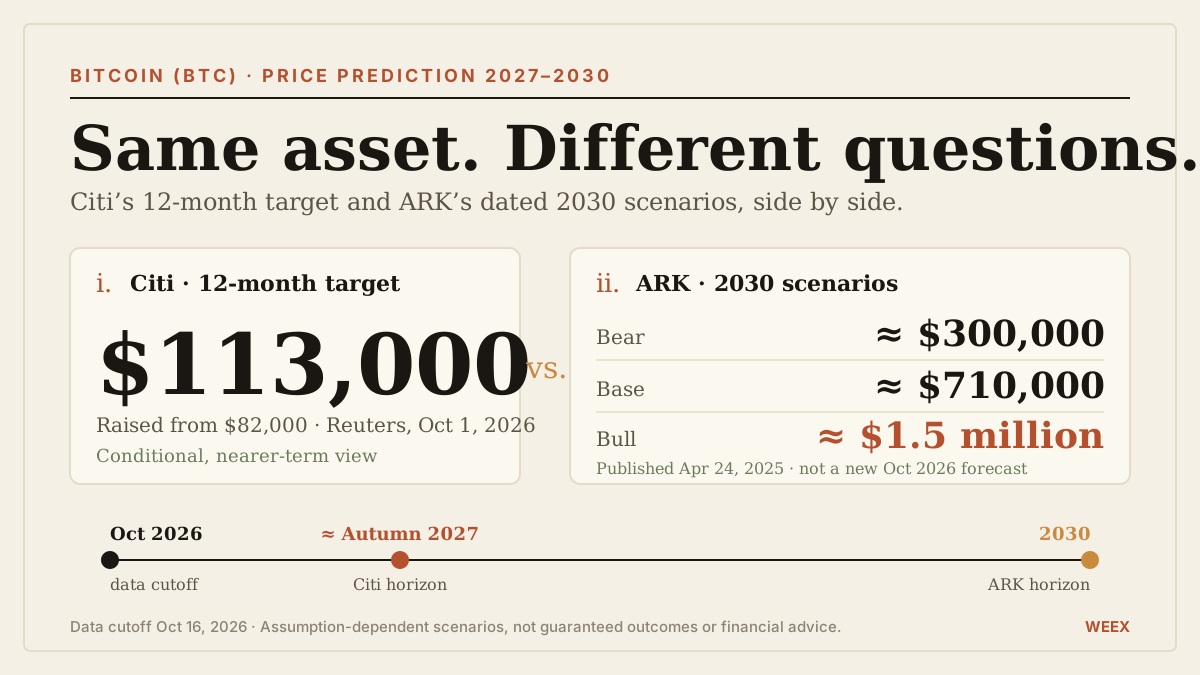
Bitcoin (BTC) Price Prediction 2027–2030: Citi’s $113,000 Target vs. Cathie Wood’s ARK Scenarios
Bitcoin price prediction for 2027–2030: compare Citi’s $113,000 target with ARK’s dated scenarios, demand assumptions, valuation math and key risks.

Crypto: 107 incidents and $1.18 billion stolen in Q3 2026

Is Pearl, Dreaming of Bitcoin in the AI Era, an Innovation or Just Simple Hype?

唐华斑竹 Analyzes Bitcoin Trends, Suggests Monitoring Support Levels
Howard Marks: If Everyone is Talking About a Bubble, Then the Bubble May Not Have Burst Yet

Quantum Alliance Established to Protect Blockchain from Quantum Computers
唐华斑竹 Analyzes the Current State of the Crypto Market, Advises Caution

U.S. Treasury Department's Survey Fails to Signal Debt Reduction, Bond Yields Rise with 10-Year Yield Back Above 5.12%
The Past and Present of Currency in the Age of Exploration
What Business Does Solana Want to Do in Shanghai?
Fractional Reserve: Reserve Requirement Abolished. Where is the Value?
Cyberattack on the ports of Marseille and La Rochelle? Hackers paid 1 dollar in crypto

G20 warns that stablecoins may lose value even if fully backed

[Legal Insights] Hard Wallet Hacking Incident: Is My Digital Asset Safe in Exchanges?
[Full Text] DAXA: "Digital Asset Taxation Should Be Linked to Basic Law Classification and Enforcement Infrastructure"

Crypto Billionaires Invest $100 Million to Disrupt UK Politics
Pump.fun 'optimized for addiction': what the internal messages cited in court really say
Is 24/7 Trading a Necessity? Analyzing the Real Trading Rhythm of RWA Perpetual Contracts
[ETH Letter] Meritz Securities Reviews Tokenization of Korean Securities Based on OP Stack
"Without Changing the Nature of Government Bonds" Toward Tokenization: Progmat's Saito Explains
LDP Proposes Establishing a Cyber Response Headquarters Ahead of Cybersecurity Crisis, Emphasizing Cryptocurrency Tracking and Post-Quantum Cryptography
Former FTX Executive Slams Netflix's New Series: Turning Financial Fraud into a 'Romantic Film' is Absurd
Contents
Latest articles




Latest coin listings on WEEX


