Wall Street Shifts Defensive Strategy to Fintech! Wedbush Covers 15 Stocks, Favoring Visa, Mastercard, and Robinhood

 Prefer us on Google



On November 26, as U.S. tech stocks experienced significant volatility, Wall Street giant Wedbush Securities downgraded its rating on Klarna Group and issued coverage ratings on 14 other fintech stocks in the U.S. market, citing a shift in the primary growth drivers of the industry.
A team led by Bank of America senior strategist Hartnett recently warned that potential AI credit event crises and a global economic "hard landing" may be underestimated, yet they maintain a cautious macro forecast based on a soft landing. In this context, Wedbush's fintech stock selection report provides a defensive perspective, focusing on companies that can continue to generate stable revenue from existing customers even as trading volumes slow.
Before Thanksgiving, NVIDIA's CEO Jensen Huang drove the Nasdaq Composite, S&P 500, and Philadelphia Semiconductor Index to surge by 6.51%, 4.73%, and 14.03% respectively on Monday, followed by a decline of 1.48%, 0.50%, and 7.88% on Tuesday. Micron Technology and AMD, leaders in the AI computing supply chain, saw their shares drop significantly from Monday's gains of 19.04% and 6.85% to declines of 11.01% and 8.86%. On Wednesday, the U.S. stock market staged a "V-shaped" rebound ahead of Thanksgiving, with the Dow Jones rising 0.33%, while the Nasdaq Composite and S&P 500 narrowed their earlier declines of about 4.6% and 3.2% to drops of 0.62% and 0.25%, respectively. The Philadelphia Semiconductor Index also narrowed its decline from nearly 8% to 0.65%.
Amid this volatility, Wedbush Securities analyst Moshe Katri downgraded the buy-now-pay-later platform Klarna to neutral with a target price of $14, while giving Visa and Mastercard outperform ratings with target prices of $487 and $751, respectively. The popular U.S. brokerage Robinhood Markets also received an "outperform" rating, while PayPal was rated neutral with a target price of $62. Katri's core judgment is that the growth focus in electronic payments is shifting from cash transactions to the incremental benefits brought by electronic payments, moving towards value-added services such as anti-fraud, cybersecurity, data analytics, and identity verification.
Wedbush Downgrades Klarna to Neutral, Affirms Visa as "Outperform"
Wedbush Securities downgraded Klarna Group's rating and issued coverage ratings on 14 other fintech stocks, citing a change in the primary growth drivers of the industry.
Klarna's rating was downgraded from "outperform" to "neutral," with a target price set at $14. On Wednesday morning, the stock saw a rare significant drop of 5.05% to $12.60.
Analyst Moshe Katri stated, "Wall Street has typically mentioned two growth drivers: one is the shift of consumers from cash and checks to electronic payments, and the other is the adoption of electronic payments by small businesses."
Katri added, "The more important growth driver now is the industry's shift from pressured transaction fees to value-added services, such as anti-fraud, cybersecurity, data analytics, rewards programs, and identity verification tools. Revenue from value-added services is defensive, grows faster, and has higher margins."
The report notes that the fintech industry typically benefits from inflation. Payment networks and merchant payment processors charge a percentage of the transaction amount, so even if the number of transactions remains flat, rising prices can drive revenue growth.
Here are the ratings and target prices announced, with target prices in USD and uppercase letters representing stock market codes.
| Company Name | Ticker | Rating | Target Price (USD) |
|---|---|---|---|
| Automatic Data Processing | ADP | Outperform | 365 |
| Block | XYZ | Neutral | 87 |
| Broadridge Financial Solutions | BR | Neutral | 202 |
| Circle Internet Group | CRCL | Neutral | 55 |
| Coinbase Global | COIN | Outperform | 127 |
| Figure Technology Solutions | FIGR | Neutral | 28 |
| Mastercard | MA | Outperform | 751 |
| Paychex | PAYX | Outperform | 134 |
| Paymentus | PAY | Outperform | 39 |
| PayPal | PYPL | Neutral | 62 |
| Robinhood Markets | HOOD | Outperform | 80 |
| Sezzle | SEZL | Outperform | 173 |
| Toast | TOST | Neutral | 35 |
| Visa | V | Outperform | 487 |
| Klarna Group | / | Neutral | 14 |
The truly defensive aspect lies in the revenue structure, with differentiation within fintech still occurring
The advantage of fintech-dominated payment networks is their ability to offer more paid services on the same transaction. Banks and merchants need not only to complete payments but also to intercept fraud while minimizing false declines of legitimate transactions, verify identities, and manage customer rewards. Payment networks can leverage existing transaction data and customer interfaces to embed these tools into authorization and risk control processes. Even if the number of transactions slows, more customers adopting these services can still drive revenue.
Mastercard's net revenue from value-added services and solutions increased from $3.423 billion to $4.058 billion in the third quarter, a growth of approximately 19%, outpacing the company's overall net revenue growth of 14%. The inflation benefit mentioned by Katri has clear conditions; businesses that charge based on transaction amounts can benefit from rising nominal prices, while actual consumption contraction or declining rates may weaken this effect.
Klarna faces a different profit mechanism. The installment business requires upfront funding for loans, relying on consumer repayments. If employment weakens, funding costs and credit losses may simultaneously erode profits from new transactions. Klarna's operating data for the third quarter has shown improvement, with transaction profits increasing by 32% year-on-year to $371 million, and the proportion of credit loss provisions to total merchandise transactions decreased from 0.72% to 0.56%. This makes the latest rating differences on Wall Street even more noteworthy.
In a pressure scenario, payment networks are mainly affected by consumption volume and fee rates, while platforms holding consumer loan exposure must also bear the impact of weakened repayment capacity. At the same time, Wedbush also gave positive ratings to Coinbase, the favorite stock trading platform for retail investors Robinhood, and Sezzle, which is also in the buy-now-pay-later space. Therefore, a more accurate interpretation is to select high-quality stocks in the fintech sector based on profit sources, credit exposure, and valuation, especially during the significant volatility in U.S. stocks and the market's defensive attributes, which are primarily reflected in the long-term stable cash flow growth business models of certain targets. The rating list itself cannot prove that funds have shifted from the rapidly rising AI infrastructure-related hardware to fintech digital payment stocks.
-- Price
This content is provided for general informational purposes only and doesn't constitute financial, investment, legal, or tax advice. Any events, rewards, online promotions, or related information mentioned herein should not be considered a recommendation, solicitation, or invitation to purchase, sell, trade, or otherwise deal in any crypto assets. Crypto assets are highly volatile and may result in loss. The availability of WEEX services, products, and related events may vary by region. You are responsible for ensuring that your participation is in accordance with applicable local laws and regulations.
You may also like

Black Friday Stock Deals: 7 Bargains Our Analysts Are Watching Now

Top LEO Satellite Stocks to Watch in 2026

TSMC Stock Price Prediction for December 2026

Alliance DAO Co-founder Predicts Strong Rebound in US Stocks Over Next 2 to 3 Months, S&P 500 May Break 8000 Points

RWA Enters the Era of 'Big Infrastructure': The Competition Just Begins After Asset Tokenization

2026 Global Venture Capital Review: AI Absorbs 90% of Financing Growth, Established Funds Still Struggle to Exit

If You Put $10,000 in the Schwab U.S. Dividend Equity ETF 10 Years Ago, Here's What You'd Have Now

Vitalik Proposes Open Sourcing Semiconductor Design, Mentions Wallet Tampering

Black Friday Approaches, Market Discounts First: No Escape for US Stocks and Crypto

Asian Stock Markets Rebound, Chinese Assets Lead the Surge, AI Trading Prospects Await Observation

From Visa Experiments to KYA Governance: Who Defines the Financial Boundaries of Agents?

Record Monthly Outflow: What Happened to Bitcoin ETFs?

Bitcoin Ranges Narrowly; Regional Equities Close Early Friday | WEEX Daily Market Brief (November 27, 2026)
Bitcoin and Ethereum traded in narrow ranges, continuing to test support at $60,000 and $1,700.Fidelity applied for a spot Chainlink ETF.Regional equities opened higher and advanced, led by AI large-model and optical communications stocks.Equities will close early on November 27, with Meituan earnings in focus.

Venezuelan Oil Tycoon Backed by Trump: All I Did Was Create Output for My Country

Why Has the Hottest Robotics Sector Become a 'Startup Graveyard' Despite $100 Billion Investment?

Former Goldman Sachs FICC Executive Herman Jin: AI Is Not the Problem, Liquidity Is; Semiconductor Turning Point May Be in Q1 2027

Elon Musk's Plan to Gift Every American Child a Share of SpaceX Annually: What's Behind It?

Bank of America’s Hartnett on 2027 U.S. Stocks: Soft Landing at 7777, Full Bubble at 8888, Hard Landing at 6666

Stablecoins Are Just the Throne: Who Holds the Real Key to On-Chain Finance?

Black Friday Kicks Off Trillion-Dollar Shopping Season! From Retail Foot Traffic Recovery to AI Buying Resurgence, Will Global Stock Markets Stage a "December Comeback" as Expected?

Conversation with Robinhood CEO: How Can Ordinary People Reclaim Wealth in the AI Era?
Deutsche Bank Predicts Three Rate Hikes and S&P 500 at 9000 Points by 2027, Driven by the Same Force

CITIC Securities: October Steel Prices Decline, Focus on High-Dividend Leaders

UNCTAD Report: Global Maritime Trade Volume Expected to Grow Zero by 2026
Meta Platforms Just Partnered With Walmart. Here's Why Investors Should Pay Attention

Glassnode Report: Institutional Funds Withdraw, Crypto Market Enters Defensive Cycle
South Korean Investors Sell 10 Trillion Won in Financial Assets to Enter Real Estate Market

Is DeFi Insurance Beyond Rescue?

Who is Pricing Stripe at $200 Billion?
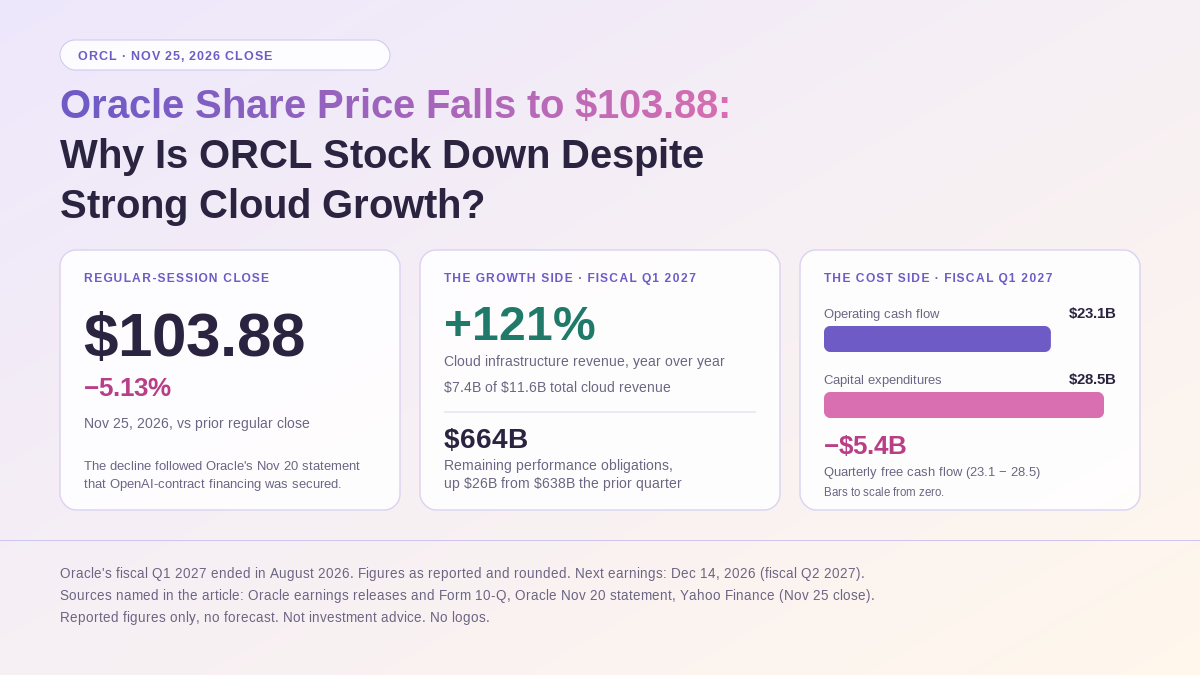
Oracle Share Price Falls to $103.88: Why Is ORCL Stock Down Despite Strong Cloud Growth?
Oracle shares fell 5.13% to $103.88. See what its $664 billion backlog, OpenAI financing, and negative free cash flow mean ahead of December earnings.
Black Friday Stock Deals: 7 Bargains Our Analysts Are Watching Now
Top LEO Satellite Stocks to Watch in 2026
TSMC Stock Price Prediction for December 2026
Alliance DAO Co-founder Predicts Strong Rebound in US Stocks Over Next 2 to 3 Months, S&P 500 May Break 8000 Points
RWA Enters the Era of 'Big Infrastructure': The Competition Just Begins After Asset Tokenization
2026 Global Venture Capital Review: AI Absorbs 90% of Financing Growth, Established Funds Still Struggle to Exit
Latest articles


Latest coin listings on WEEX