Bank of America Releases 2027 Investment Outlook: Global Stock Markets Could Rise 4%-8%! Improved Financial Environment Allows for Cryptocurrency Investments

 Prefer us on Google



In the context of the macro trends of the global capital markets for 2027, Michael Hartnett, Chief Investment Strategist at Bank of America (BofA), has provided a clear benchmark projection. According to a report by Dow Jones Newswire on November 24, Hartnett has set economic soft landing as the core theme of the 2027 investment outlook, predicting that as the interest rate hike cycles of major global central banks gradually come to an end, the global stock market is expected to welcome a more relaxed upward window.
Under this benchmark scenario, if the expectation of approximately 10% year-on-year growth in global corporate profits is realized, the potential upward range for global stock markets is estimated to be between 4% and 8%. At the same time, the report also outlines two extreme scenarios regarding possible significant deviations in the macro situation: the continuation of the AI boom and a hard landing of the U.S. economy, with corresponding target points for the S&P 500 index set at 8888 points and 6666 points, respectively.
Breaking down the timeline for the shift in monetary policy, Hartnett estimates that from the current point until June 2027, central banks in multiple countries are expected to raise interest rates a total of 38 times, while entering the second half of 2027, the policy direction is likely to switch to a cumulative reduction of 21 times. This set of statistics covering multiple global central banks outlines a transition trajectory from a tightening liquidity environment to a more accommodative one.
Based on the aforementioned liquidity turning point judgment, Hartnett analyzes that if the overall financial environment can see substantial improvement around March to April next year, funds that have been on the sidelines and holding cash can gradually shift their focus towards semiconductors, commodities, cryptocurrencies, and consumer stocks when assessing risk assets. The common characteristic of these four sectors is that their valuations and performance are highly sensitive to changes in macroeconomic conditions and funding costs.
However, the macro backdrop of a soft landing does not necessarily mean that corporate profits will inevitably catch up with market optimism. BofA's current estimate of about 10% growth in global corporate profits is already below the general market consensus; based on this cautious assessment, Hartnett still tends to maintain patience in strategy, emphasizing that it is unwise to prematurely bet all positions on high-volatility risk assets.
S&P 500 Dual Scenario Projection
In the bullish optimistic scenario, if the capital expenditure boom in the AI sector continues to expand, the S&P 500 index theoretically has the space to rise to 8888 points. However, Hartnett clearly points out that this trend is not a foregone conclusion and still needs to overcome key political and industrial thresholds—namely, bipartisan compromises in the U.S. Congress on healthcare issues and data center infrastructure construction to ensure that large-scale infrastructure investments can proceed smoothly. Additionally, a significant drop in international oil prices and large-scale fiscal stimulus measures from China are also listed by BofA as potential catalysts that could trigger market upside beyond expectations.
Conversely, this optimistic projection also faces multiple vulnerabilities. Should a credit default event occur within the AI supply chain, high-end chip prices plummet, or the Federal Reserve adopts a more aggressive stance than the market expects to bring inflation back to the 2% target, it could directly undermine the bullish logic.
On the other end of the spectrum lies the pessimistic scenario of a hard landing for the U.S. economy—if recession risks materialize, the S&P 500 index could face downward pressure to 6666 points. What keeps the strategy team highly alert is the current market's extremely uniform optimistic sentiment: in a fund manager survey conducted in November, only 3% of responding institutional investors expected a hard landing for the economy. In Hartnett's view, such a stark disparity in expectations reflects that funds are still overly optimistic about macro cycles and corporate profits; should actual data fall short of expectations, the pressure for valuation correction will subsequently increase.
Distinct Paths of Offense and Defense
Faced with two vastly different macro projections of cyclical recovery and economic hard landing, the corresponding asset allocation logic also shows a clear distinction between offense and defense. If the U.S. economy ultimately slides into a hard landing, Hartnett proposes a defensive framework called GRAB allocation strategy, advocating for a significant increase in the weight of government bonds, real estate, AAA-rated defensive assets, and gold within the asset portfolio; this risk-averse structure sharply contrasts with the offensive stance that emphasizes cyclical sectors and cryptocurrencies under the soft landing expectation.
In fact, the financing and credit risks hidden within the AI sector have already attracted the attention of other core research teams at BofA. Chris Hyzy, Chief Investment Officer of BofA Private Bank, warned in a market analysis released on November 23 that current investor concerns regarding the actual returns on massive capital investments in artificial intelligence and the subsequent availability of financing are rising, and this worry has already begun to transmit in the bond market, leading to an expansion of spreads on lower-quality credit assets.
Looking through the two sets of S&P 500 points provided by Hartnett, they reflect distinctly different market funding flows: when the financing environment warms up and corporate profit growth keeps pace, external funds have ample reason to flow back into the cyclical recovery and technology growth assets; conversely, if persistently high interest rates first crush terminal demand and corporate capital expenditure, the safe havens for funds will quickly switch to traditional defensive positions such as government bonds and gold.
-- Price
This content is provided for general informational purposes only and doesn't constitute financial, investment, legal, or tax advice. Any events, rewards, online promotions, or related information mentioned herein should not be considered a recommendation, solicitation, or invitation to purchase, sell, trade, or otherwise deal in any crypto assets. Crypto assets are highly volatile and may result in loss. The availability of WEEX services, products, and related events may vary by region. You are responsible for ensuring that your participation is in accordance with applicable local laws and regulations.
You may also like

Black Friday Stock Deals: 7 Bargains Our Analysts Are Watching Now

Top LEO Satellite Stocks to Watch in 2026

TSMC Stock Price Prediction for December 2026

Alliance DAO Co-founder Predicts Strong Rebound in US Stocks Over Next 2 to 3 Months, S&P 500 May Break 8000 Points

RWA Enters the Era of 'Big Infrastructure': The Competition Just Begins After Asset Tokenization

2026 Global Venture Capital Review: AI Absorbs 90% of Financing Growth, Established Funds Still Struggle to Exit

If You Put $10,000 in the Schwab U.S. Dividend Equity ETF 10 Years Ago, Here's What You'd Have Now

Vitalik Proposes Open Sourcing Semiconductor Design, Mentions Wallet Tampering

Black Friday Approaches, Market Discounts First: No Escape for US Stocks and Crypto

Asian Stock Markets Rebound, Chinese Assets Lead the Surge, AI Trading Prospects Await Observation

From Visa Experiments to KYA Governance: Who Defines the Financial Boundaries of Agents?

Record Monthly Outflow: What Happened to Bitcoin ETFs?

Bitcoin Ranges Narrowly; Regional Equities Close Early Friday | WEEX Daily Market Brief (November 27, 2026)
Bitcoin and Ethereum traded in narrow ranges, continuing to test support at $60,000 and $1,700.Fidelity applied for a spot Chainlink ETF.Regional equities opened higher and advanced, led by AI large-model and optical communications stocks.Equities will close early on November 27, with Meituan earnings in focus.

Venezuelan Oil Tycoon Backed by Trump: All I Did Was Create Output for My Country

Why Has the Hottest Robotics Sector Become a 'Startup Graveyard' Despite $100 Billion Investment?

Former Goldman Sachs FICC Executive Herman Jin: AI Is Not the Problem, Liquidity Is; Semiconductor Turning Point May Be in Q1 2027

Elon Musk's Plan to Gift Every American Child a Share of SpaceX Annually: What's Behind It?

Bank of America’s Hartnett on 2027 U.S. Stocks: Soft Landing at 7777, Full Bubble at 8888, Hard Landing at 6666

Stablecoins Are Just the Throne: Who Holds the Real Key to On-Chain Finance?

Black Friday Kicks Off Trillion-Dollar Shopping Season! From Retail Foot Traffic Recovery to AI Buying Resurgence, Will Global Stock Markets Stage a "December Comeback" as Expected?

Conversation with Robinhood CEO: How Can Ordinary People Reclaim Wealth in the AI Era?
Deutsche Bank Predicts Three Rate Hikes and S&P 500 at 9000 Points by 2027, Driven by the Same Force

CITIC Securities: October Steel Prices Decline, Focus on High-Dividend Leaders

UNCTAD Report: Global Maritime Trade Volume Expected to Grow Zero by 2026
Meta Platforms Just Partnered With Walmart. Here's Why Investors Should Pay Attention

Glassnode Report: Institutional Funds Withdraw, Crypto Market Enters Defensive Cycle
South Korean Investors Sell 10 Trillion Won in Financial Assets to Enter Real Estate Market

Is DeFi Insurance Beyond Rescue?

Who is Pricing Stripe at $200 Billion?
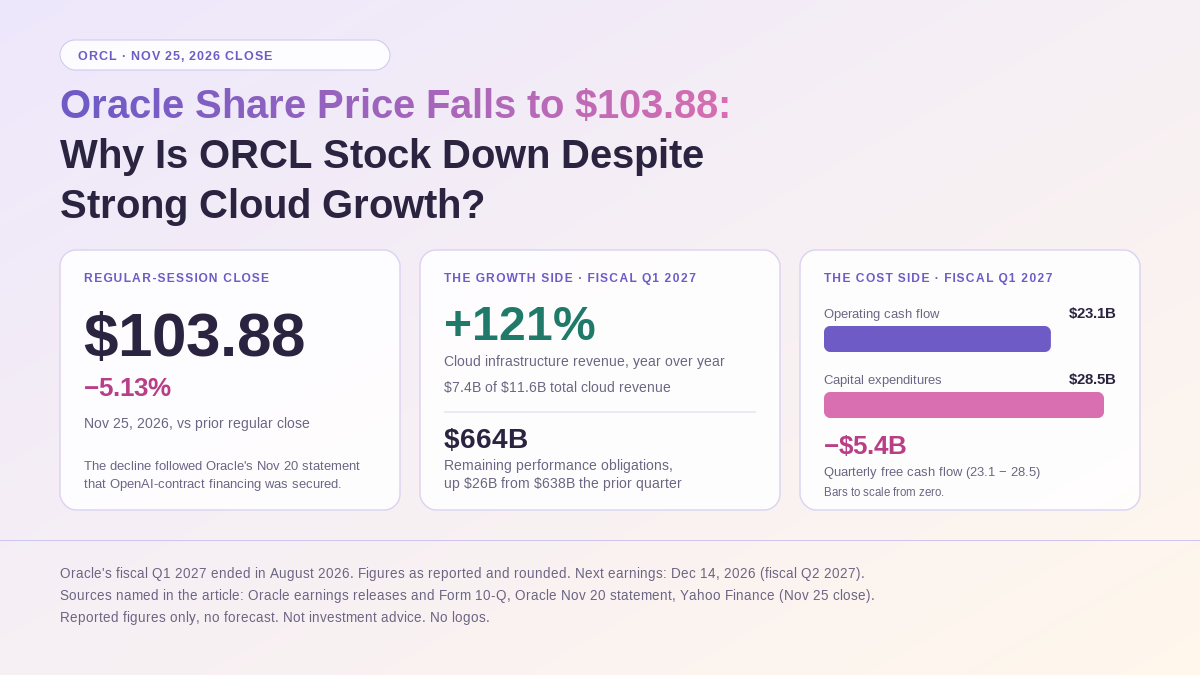
Oracle Share Price Falls to $103.88: Why Is ORCL Stock Down Despite Strong Cloud Growth?
Oracle shares fell 5.13% to $103.88. See what its $664 billion backlog, OpenAI financing, and negative free cash flow mean ahead of December earnings.
Black Friday Stock Deals: 7 Bargains Our Analysts Are Watching Now
Top LEO Satellite Stocks to Watch in 2026
TSMC Stock Price Prediction for December 2026
Alliance DAO Co-founder Predicts Strong Rebound in US Stocks Over Next 2 to 3 Months, S&P 500 May Break 8000 Points
RWA Enters the Era of 'Big Infrastructure': The Competition Just Begins After Asset Tokenization
2026 Global Venture Capital Review: AI Absorbs 90% of Financing Growth, Established Funds Still Struggle to Exit
Latest articles


Latest coin listings on WEEX