
AI Financing, Earnings Reports, and Political Risks: The Market Questions Industry Investment Returns

 Prefer us on Google



On November 1, the AI boom is facing triple pressure from the bond market, corporate earnings reports, and political risks in the United States. As financing thresholds rise, the free cash flow of tech giants deteriorates, and public opposition to data center construction grows, investors are shifting from chasing computing power growth to scrutinizing whether AI investments can deliver returns.
The bond market is the first to release pressure. AI cloud service providers such as CoreWeave, Nebius, and Nscale have recently been almost shut out of the high-yield bond issuance market. The 9.75% coupon bond issued by CoreWeave earlier this year now has a secondary market yield exceeding 15%. The scale of AI-related issuances in the U.S. corporate bond market has risen from $394 billion in 2025 to $655 billion as of mid-October this year, with analysts predicting that new AI-related debt could approach $1 trillion next year. The surge in financing supply and concentrated investor risk exposure are driving up corporate financing costs.
The earnings season further exacerbates market concerns. Alphabet has reported negative free cash flow for the second consecutive quarter, with its stock price plummeting 13% in a single day post-earnings, resulting in a market cap loss of about $500 billion; Amazon's negative free cash flow for the quarter is nearly $35 billion, while Meta faces pressure due to increased capital expenditure plans, leading S&P to downgrade its credit rating outlook to negative. Among the four major cloud providers, only Microsoft recorded positive free cash flow for the quarter, reaching $18.6 billion.
The impact of AI is also spreading to the software industry. ServiceNow's stock price fell 31% in a single day due to quarterly sales outlooks falling short of expectations; Twilio dropped 18%. The market is beginning to worry that generative AI products may weaken the pricing power and profit margins of traditional software companies.
Political risk has become another uncertainty. With the U.S. midterm elections approaching, controversies surrounding electricity prices, environmental issues, and employment related to data center construction are heating up. Polls show that about two-thirds of Americans oppose the construction of new data centers. If the Democrats regain control of Congress, the AI industry may face more intense investigations, hearings, and regulatory scrutiny, and the costs of data center construction and operation may also be affected.
The core change in the market is that AI investment is transitioning from a scale competition to a return verification phase. Creditors are demanding higher yields and stricter protection terms, while equity investors are increasingly focused on free cash flow, capital expenditure discipline, and profitability. Demand for AI remains strong, but simply increasing computing power investments is no longer sufficient to support valuations. Whether companies can convert massive capital expenditures into actual revenue and profits is becoming a critical dividing line among enterprises.
-- Price
This content is provided for general informational purposes only and doesn't constitute financial, investment, legal, or tax advice. Any events, rewards, online promotions, or related information mentioned herein should not be considered a recommendation, solicitation, or invitation to purchase, sell, trade, or otherwise deal in any crypto assets. Crypto assets are highly volatile and may result in loss. The availability of WEEX services, products, and related events may vary by region. You are responsible for ensuring that your participation is in accordance with applicable local laws and regulations.
You may also like

Why Did Institutions Bet $40 Million on PhotonPay When Stablecoin Transfers Are Cheap Enough?

TradingBeats Launches New Version, Upgraded to Information Stream Format
The Ghost Behind the Screen: Unveiling the Secret World of North Korean Hackers Lazarus

Where Did the Liquidity Go on the Night Binance Suspended Withdrawals?

WEEX Exclusive:Major Indexes Rise After Election Clarity, Oil Plunges| WEEX Daily Market(November 5, 2026)

Cryptocurrency Exchanges Enter the U.S. Stock Derivatives Market as CFTC Approves Perpetual Futures Amid Wall Street Backlash

Major Indexes Rise After Election Clarity, Oil Plunges| WEEX Daily Market(November 5, 2026)
At the November 4 close, all three major indexes rose. Risk assets rebounded after election clarity, but AI-related stocks broadly declined. Brent and WTI oil both fell more than 9% over 24 hours. Bitcoin briefly rose above $80,000, and the crypto market warmed across the board. TRUMP token plunged. November 5 focus is earnings from Moderna, Sony, ConocoPhillips and others.

AI Infrastructure May Lose Financing Before Losing Customers

3Jane and Settle Reach $100 Million Financing Agreement

Why Banks Still Refuse to Open Accounts for Licensed Crypto Payment Projects
Nvidia stock tokens show price spreads, but slippage crushes the arbitrage

Serenity: AI Industry Chain Stocks Face Indiscriminate Sell-off, Some Storage Stocks Have a P/E Ratio of Only 1.6 Times

Over $133 Million in Suspected Stolen Funds Flow Through Crypto Platforms

The 'Election Effect' of Bitcoin: Political Catalyst or Coinciding with the Halving Cycle?

TeraWulf Signs Credit Support Agreement with Google to Advance $19 Billion Data Center Project

Gold Token 2026: Why Move Gold on Chain?
Copom Expected to Pause Selic Cuts: What Changes for Investors
Democrats Sweep Congress: 12 Key Questions Investors Are Asking

Stablecoins Move Towards Real Payments: Three Technical Advantages of TBC

Is Vitalik Buterin's Digital Minimalism Worth Having?
Suspected North Korean Hackers Transfer Approximately $1.46 Million via Jupiter Lend and Circle
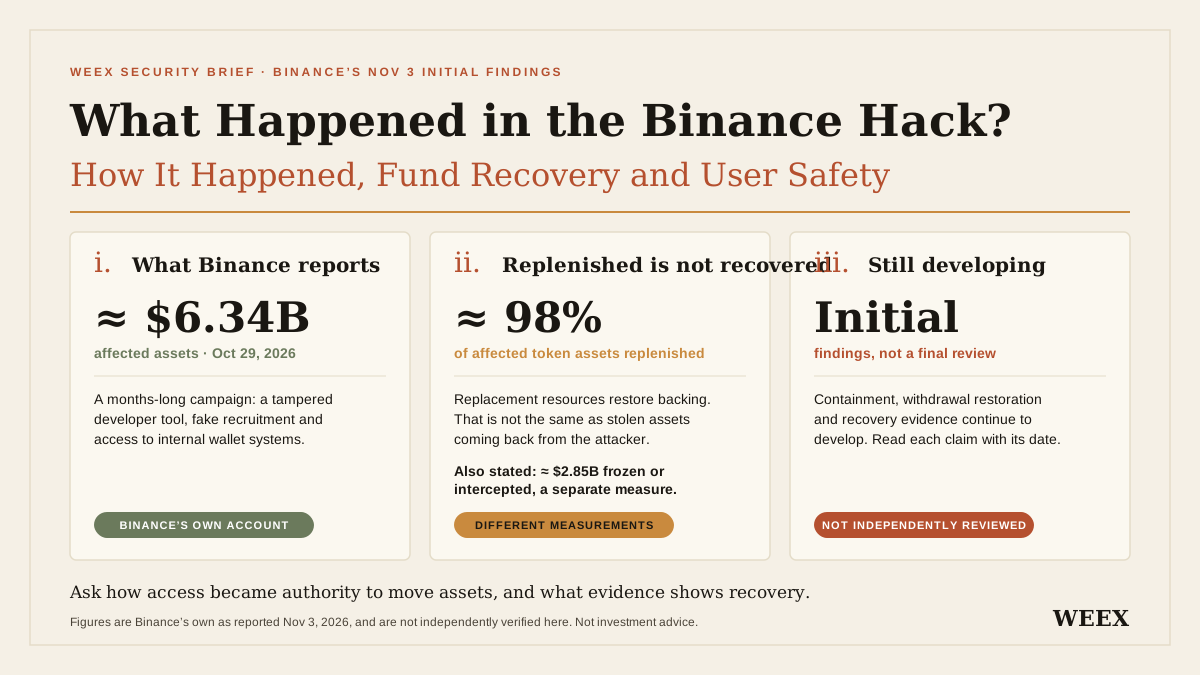
What Happened in the Binance Hack? How It Happened, Fund Recovery and User Safety
What happened in the Binance hack? Review the attack timeline, latest fund replenishment, recovery limits and practical steps to protect your account.

Bitcoin ETF Outflows Hit $398.6M on November 2 as BlackRock Leads Redemptions

Waiting for the Last Dip? Morgan Stanley's Wilson: Regardless of Election Results, It May Be a Good Opportunity to Buy U.S. Stocks

Standard Chartered Launches Continuous Tokenized Deposits in Hong Kong

Judy Shelton and Monetary Policy Point to a Less Dominant Future for the Fed

Bitcoin’s year-end liquidity hopes face a projected $150 billion Treasury cash rebuild

ICE Partners with Hyperliquid, Traditional Exchanges' Moat is Shifting
Dollar stablecoin use stayed elevated after capital controls ended, new research suggests

The "Election Effect" of Bitcoin: Political Catalyst or Coinciding with the Halving Cycle?
Why Did Institutions Bet $40 Million on PhotonPay When Stablecoin Transfers Are Cheap Enough?
TradingBeats Launches New Version, Upgraded to Information Stream Format
The Ghost Behind the Screen: Unveiling the Secret World of North Korean Hackers Lazarus
Where Did the Liquidity Go on the Night Binance Suspended Withdrawals?
WEEX Exclusive:Major Indexes Rise After Election Clarity, Oil Plunges| WEEX Daily Market(November 5, 2026)
Cryptocurrency Exchanges Enter the U.S. Stock Derivatives Market as CFTC Approves Perpetual Futures Amid Wall Street Backlash
Contents
Latest articles




Latest coin listings on WEEX


